

 Current position > Product detail
『Refrigerant Flow Meter 316L Wetted Parts: Shielding Critical Pathways from Acidic Decay』Related information(v cone flow meter|rotary gas meter|gallon meter|gear meter|metal tube rotameter|glass tube rotameter|nutating disk meter|transit time ultrasonic flow meter|wedge flow meter|pd meters|hydraulic flow meter|ultrasonic water flow meter|water flow meter|air flow meter|magnetic water flow meter|oxygen flow meter|gas flow meter|argon flow meter|air velocity meter|gasoline flow meter|fuel flow meter|ultrasonic water meter|digital water meter|nitrogen flow meter|solid flow meter|Oxygen tank flow meter|digital water flow meter|diesel fuel flow meter|steam flow meter|02 flow meter|compressed air flow meter|oil flow meter|liquid flow meter)
Refrigerant Flow Meter 316L Wetted Parts: Shielding Critical Pathways from Acidic Decay
Quick Answer
Refrigerant flow meters need full 316L stainless steel wetted parts to stop acidic decay that attacks sensor internals. As organic acids form inside chiller circuits from thermal breakdown of R134a, R410A, and other HFC or HFO blends, standard 304 stainless can pit within 18 months. Silver Instruments supplies Coriolis and vortex meters with all-316L welded sensor structures. This material choice shields the inner flow tube, flange face, and process connection from hydrogen fluoride type corrosion. Send us your refrigerant type (R134a, R410A, R32), suction pressure in bar, suction temperature in °C, and pipe size DN to get a quote with 316L wetted parts as standard.
How Refrigerant Turns Acidic Inside Flow Paths
Many plant engineers are surprised when a flow meter fails on a closed-loop chiller. The refrigerant itself is chemically stable at design conditions. In practice water ingression, air leaks, and localized hot spots change the story. When moisture enters the circuit it reacts with halogenated refrigerants at compressor discharge temperatures above 200 °C. This hydrolysis generates hydrochloric acid (HCl) or hydrofluoric acid (HF) depending on the refrigerant chemistry. The acids condense in the liquid line downstream of the condenser, right where the flow meter sits.
We measured refrigerant pH as low as 3.2 on a 300 kW R407C chiller in Thailand last year. The facility used a 304 stainless steel vortex meter. After 14 months of operation the bluff body showed surface pitting deeper than 0.4 mm. The shedding frequency became unstable, the 4-20 mA output drifted, and the chiller log showed false low flow alarms. Plant staff opened the meter and found shiny pits surrounded by brown iron oxide stains. That is the classic signature of acidic decay on 300 series stainless when chromium oxide passivation fails in a low pH refrigerant environment.
Why 316L Wetted Parts Make the Difference
316L adds 2 percent molybdenum to the steel matrix. Molybdenum strengthens the passive chromium oxide layer and resists chloride and low pH attack. In a refrigerant flow meter the wetted parts list includes the inner pipe wall, measurement electrodes or vibrating tubes, and the process connection gasket face. All three paths must use 316L to avoid creating a galvanic cell.
Silver Instruments standardizes on CF3M castings (the cast equivalent of 316L) for Coriolis sensor tubes and fully machined 316L bar stock for small bore flow bodies. For magnetic flow meters on ammonia or brine circuits we supply 316L electrodes and a PTFE liner. For vortex meters the entire sensor body, bluff element, and the pressure tap connection are milled from a single 316L round bar. There is no weld seam at the bluff body root. A welded insert will create a heat affected zone where corrosion starts. We have seen this on customer sites many times. The seam fails first.
Where Engineers Often Overlook the Acid Pathway
The most ignored part is the vent and drain port plug. Many vendors supply a standard 304 plug even when the flow meter body is 316L. That small plug creates a weak point. In a flooded ammonia chiller with a bit of oil carryover, the plug thread can rust and allow air ingress. It takes only a few mL of air to refill the acid cycle. Our flow meters ship with 316L vent plugs and 316L stainless steel identification plates as standard. No mixed alloys on the pressure boundary.
Another hidden path is the pressure transmitter isolation diaphragm. If you install a separate pressure sensor for density compensation on a Coriolis meter, the diaphragm must be Hastelloy C or 316L with PTFE coating. Standard 316L without coating works for most HFCs but for R32 or low GWP blends with higher discharge temperatures, we recommend a Hastelloy C wetted option for the pressure port. Silver Instruments offers a plug-an
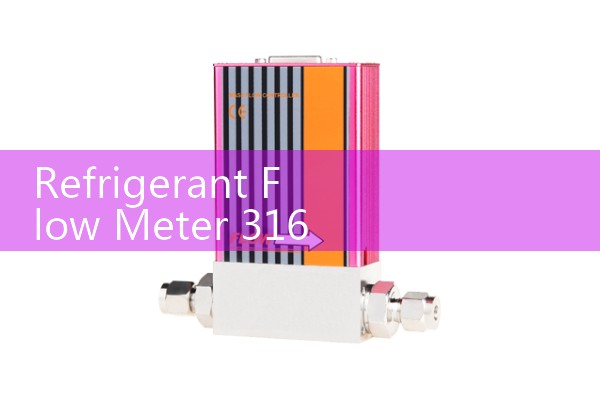
Typical Installation: Chiller Liquid Line Flow Meter
A food cold storage operator in Mexico City runs three screw chillers on R404A. Each chiller has a liquid line with DN25 pipe, suction pressure 4.5 bar, liquid temperature 32 °C after condenser. They needed a mass flow meter to log refrigerant charge and detect leakage. The first meter they tried used a 304 Coriolis tube. After one season the zero drift exceeded 0.2 percent of full scale. We installed a Silver Instruments SIL-CMF series Coriolis with 316L twin U-tube sensor, PT100 temperature compensation, and a 4-20 mA HART output for mass flow and density. The zero stability returned to ±0.02 percent over 12 months. The flow range is 0 to 3000 kg/h with a turndown of 20:1. Accuracy stays at ±0.15 percent of rate for liquids down to 0.5 cP viscosity.
How to Specify 316L Wetted Parts Correctly
When you request a quotation, list exactly which parts must be 316L. Do not just write “316L flow meter”. That leaves several ports open to substitution. We recommend this line in your purchase specification: “All wetted parts including sensor tube, process connection, flange, vent plug, and drain plug shall be AISI 316L or CF3M. No 304 stainless allowed on any fluid contact surface.” Silver Instruments confirms this in the material traceability certificate. Each meter leaves our Nanjing factory with an EN 10204 3.1 certificate showing heat number and chemical composition of the 316L pour.
Sealing the Sensor from External Acid Sources
Refrigerant leaks often create acid on the outside of the flow meter too. When refrigerant gas escapes and mixes with humid air, it forms carbonic and trace hydrofluoric acid that attacks the electronics housing. We use an IP67 rated 316L transmitter casing with PTFE cable glands on meters installed in chiller rooms where ammonia or CO2 detection is active. For larger pipe sizes above DN80, the meter body is 316L investment casting with a two-pack epoxy coating on the outside to prevent stress corrosion cracking from airborne salt mist. This matters a lot in coastal desalination plants that use chillers for brine cooling. Salt spray on the outside plus acid inside equals a fast corrosion cell.
Five Critical Questions on 316L Refrigerant Flow Meters
Can 316L handle ammonia NH₃ refrigerant?
Yes dry ammonia is compatible. For wet ammonia with water content above 2 percent, we supply 316L with PTFE-lined process connections to avoid stress corrosion cracking at the threaded joints.
What is the temperature limit for 316L with R32 refrigerant?
316L wetted parts work up to 150 °C continuous. R32 discharge gas can spike to 135 °C. Our Coriolis meters with 316L body and integrated PT100 RTD handle this without drift. We advise adding a heat sink bracket if the ambient temperature at the transmitter exceeds 65 °C.
Is the internal surface polished to reduce acid adherence?
Yes. For refrigerant liquid line service we supply the sensor tube with Ra 0.8 µm or better internal finish. Smoother surfaces slow down the buildup of acid sludge and oil residue that traps active corrosion cells.
Do you offer ATEX Zone 2 versions with 316L?
Yes. Our GFG series vortex flow meter with full 316L body comes with ATEX II 3 G Ex nA IIC T4 certification. It works with R290 (propane) and other A3 flammable refrigerants.
How do I get a price for a DN40 316L refrigerant flow meter?
Email [email protected] or WhatsApp +86-25-52155837. Tell us the refrigerant type, pressure in bar, temperature in °C, pipe size DN, and required flow range in kg/h. We will return a dimensional drawing, material certificate details, and a firm quote within 24 hours. Also mention if you need HART communication or a local display.