

 Current position > News detail
『Vortex Steam Flow Meter: High-Temperature Saturated Vapor Processing Controls』Related information(v cone flow meter|rotary gas meter|gallon meter|gear meter|metal tube rotameter|glass tube rotameter|nutating disk meter|transit time ultrasonic flow meter|wedge flow meter|pd meters|hydraulic flow meter|ultrasonic water flow meter|water flow meter|air flow meter|magnetic water flow meter|oxygen flow meter|gas flow meter|argon flow meter|air velocity meter|gasoline flow meter|fuel flow meter|ultrasonic water meter|digital water meter|nitrogen flow meter|solid flow meter|Oxygen tank flow meter|digital water flow meter|diesel fuel flow meter|steam flow meter|02 flow meter|compressed air flow meter|oil flow meter|liquid flow meter)
Vortex Steam Flow Meter for High-Temperature Saturated Vapor Processing Controls
Quick Answer: For saturated steam up to 350 °C, a vortex flow meter with integrated temperature and pressure compensation gives you mass flow directly. Silver Instruments vortex meters handle pipe sizes from DN15 to DN300 and pressures up to 40 bar. Send us your pipe size, steam pressure, and temperature, and we will recommend a model with the right sensor and transmitter.
Why Vortex Technology Works Well for Saturated Steam
Vortex flow meters have no moving parts. A bluff body inside the pipe creates alternating vortices as steam flows past. A piezoelectric sensor counts these vortices. The vortex frequency is proportional to flow velocity. In saturated steam lines, this simple design means you get reliable measurement without worrying about bearings, gears, or lubricant breakdown at high temperatures.
Steam brings its own challenge. Saturated steam can drop out into condensate during start up or low loads. A vortex meter with a properly sized wafer body and sensor that is immune to small amounts of condensate will keep reading. Over the last twelve years we have shipped hundreds of vortex meters to steam users in Southeast Asia and the Middle East. The feedback is consistent. Engineers trust the meter once they verify the first few weeks of data against their boiler feed water meter.
What Makes a Meter Suitable for High-Temperature Saturated Vapor
Temperature rating comes first. Standard vortex meters stop at 250 °C. For high-temperature saturated steam you need a meter built with a sensor that can handle up to 350 °C without drift. Silver Instruments uses a special piezoelectric crystal assembly with an isolation path that keeps heat away from the electronics. The converter housing is separated from the sensor. On a 300 °C steam header the electronics remain cool enough to touch.
Pressure containment matters just as much. Saturated steam at 20 bar has a temperature around 212 °C. At 30 bar you see 234 °C. The meter body must match the flange rating. We cast our wafer and flanged bodies from 316L stainless steel and design them for PN40 or ANSI Class 300 as standard. For higher ratings we go to PN63 or Class 600 with full penetration welds.
Here is the thing. You also need temperature and pressure compensation built in. Without it the meter gives you volume flow at actual conditions. But saturated steam contracts and expands a lot. A 10 °C change shifts density by several percent. So we integrate a PT100 temperature sensor and a pressure transmitter. The flow computer inside the transmitter applies the IAPWS‑IF97 steam table in real time. The output is mass flow in kg/h or t/h, plus density and heat flow if you need it. For boiler house billing this combination is hard to beat.
Installation Needs That Engineers Often Overlook
Straight pipe runs are not optional. A vortex meter needs 15D upstream and 5D downstream where D is the pipe inner diameter. In a compact boiler house you may not have that. In practice, we help clients select a meter with a built‑in flow conditioner when space is tight. This adds a few hundred dollars but keeps accuracy within ±0.75 % of rate.
Most engineers skip the part about wet steam. Saturated steam near the boiler can carry 2 % to 5 % water. That water hits the bluff body at 30 m/s and over time it erodes stainless steel. We always recommend a steam separator or a drain pocket 10 pipe diameters upstream. A customer in Indonesia learned this the hard way. Their first meter survived only eight months. After a simple drain pocket the replacement has been running for four years.
Orientation is also critical. Install the meter in a horizontal pipe with the electronics facing up or to the side. Vertical upward flow works well too. Avoid vertical downward flow. Condensate can pool around the sensor and cause low bias in the reading.
Where We See These Meters Every Day
Textile mills in Vietnam and Bangladesh use our vortex meters on steam headers feeding dyeing machines and drying cylinders. Saturated steam at 8 bar to 12 bar and 175 °C to 190 °C is typical. The plant manager tracks steam cost per kilogram of fabric. A 2 % improvement in measurement pays for the meter in a few months.
Palm oil refineries in Indonesia and Malaysia run steam ejectors and sterilizers. Steam pressure is often 25 bar to 30 bar, saturated. Our flanged DN80 and DN100 meters with high‑temperature sensor go straight into these lines. The meter body handles the pressure and the condensate slugs during warm‑up without failing.
Beverage plants in the Philippines and East Africa use clean steam for SIP (sterilization‑in‑place). Temperature is 140 °C to 165 °C, lower than p
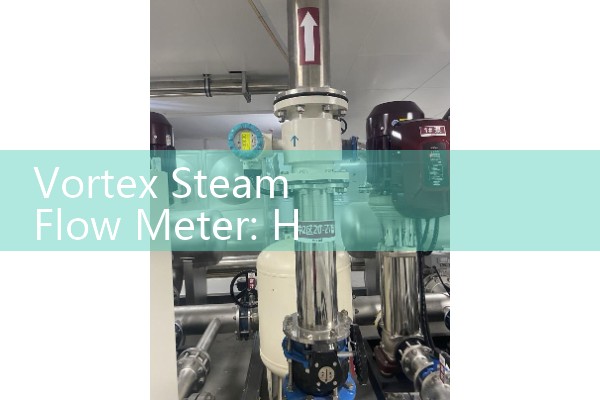
A paint manufacturer in Thailand measures saturated steam at 10 bar going into jacketed mixing vessels. They needed a meter that could handle short flow peaks during vessel heat‑up and long periods of low flow during blending. Our vortex meter with a turndown ratio of 1:20 worked without needing two separate meters. They now use one DN50 meter per reactor line and report batch steam consumption to their ERP system.
How to Specify the Right Meter for Your Steam Line
We need four numbers to select a meter: pipe size (DN), minimum and maximum steam flow rate (kg/h), operating pressure (bar), and temperature (°C). From there our engineers pick the bluff body size, the sensor temperature class, and the transmitter configuration. We also ask about the ambient environment. If the meter is installed outdoors in Saudi Arabia or Northern Australia with 50 °C ambient, we add a sun shield and specify electronics that can handle 80 °C inside the housing.
Output signals are configurable. Most clients request 4‑20 mA HART for the DCS, plus a pulse output for their energy management system. If you use Modbus RTU, we can add RS485 directly. For hazardous areas we offer ATEX Zone 1 or IECEx certification with intrinsically safe circuits.
Do not guess the flow range. We have seen projects where the meter was oversized by 200 % and the vortex signal became weak at turndown. Tell us the expected minimum flow during summer low production, not just peak winter loads. This lets us set the cutoff correctly.
A Real Example from a Feed Mill in Vietnam
Last year a shrimp feed producer in Can Tho approached us. They had a 100 mm saturated steam line at 9 bar, temperature 177 °C. Their old turbine meter was worn out and gave inconsistent readings. Condensate collected overnight caused the rotor to stick. We proposed a Silver Instruments vortex meter, DN100, PN16 flanged, with integrated PT100 and a pressure transmitter on a ½ inch branch upstream. The meter transmitter was suspended below the pipe using a bracket to avoid heat damage, something their local installer appreciated.
After installation the mass flow output matched their boiler feed water meter within 1.2 %. They now use the meter readings for monthly steam cost allocation between extrusion lines and dryers. The payback period was under five months. The site manager still sends us a WeChat message every Lunar New Year to say the meter has not drifted.
How to Order from Silver Instruments
Send us the steam pressure (bar), temperature (°C), pipe size (DN), and minimum and maximum flow (kg/h). Our applications team will reply with a model code, price, and lead time. You can reach us by phone at +86-25-68650347, on Whatsapp at +86-25-52155837, or on WeChat at +86 15365082610. We ship to over sixty countries and provide manuals in English, Spanish, and Portuguese. Each meter leaves the factory with a calibration certificate traceable to national standards.
FAQ
Can the vortex meter measure superheated steam as well?
Yes. The same meter handles saturated and superheated steam. For superheated steam the density is lower at a given pressure so you must verify that the flow velocity stays above the minimum Reynolds number. Our standard meter works for superheated steam up to 350 °C.
Do I need a flow computer or will the transmitter do mass flow?
The transmitter does mass flow and heat flow internally. You do not need a separate flow computer. The temperature sensor and pressure transmitter connect directly to the vortex transmitter. The calculation follows IAPWS‑IF97.
What is the minimum flow that can be measured on a DN50 line?
For saturated steam at 10 bar in a DN50 pipe, the minimum measurable flow is around 75 kg/h. Below that the vortex signal becomes irregular. For lower flows we recommend reducing the pipe size or using a different technology like thermal mass for clean gases.
How often do vortex meters need recalibration?
Vortex meters have no drift in the primary signal because the bluff body geometry does not change. We suggest verifying the temperature and pressure sensors every 24 months as part of your plant maintenance schedule. If the meter body sees erosion from wet steam, check it more often.
Can the meter be installed vertically with flow downward?
We do not recommend it. Vertical downward flow can trap condensate around the sensor. If you must install vertically, choose upward flow and ensure the line stays full of steam with no liquid pooling.