

 Current position > News detail
『Endress Hauser Thermal Mass Flow Meter t-mass Series: Direct Mass Flow Sizing for Low Gases』Related information(v cone flow meter|rotary gas meter|gallon meter|gear meter|metal tube rotameter|glass tube rotameter|nutating disk meter|transit time ultrasonic flow meter|wedge flow meter|pd meters|hydraulic flow meter|ultrasonic water flow meter|water flow meter|air flow meter|magnetic water flow meter|oxygen flow meter|gas flow meter|argon flow meter|air velocity meter|gasoline flow meter|fuel flow meter|ultrasonic water meter|digital water meter|nitrogen flow meter|solid flow meter|Oxygen tank flow meter|digital water flow meter|diesel fuel flow meter|steam flow meter|02 flow meter|compressed air flow meter|oil flow meter|liquid flow meter)
Endress Hauser t-mass Series Direct Mass Flow Sizing for Low Gas Flows
Quick Answer: The Endress Hauser t-mass series thermal mass flow meter gives direct gas mass flow output without pressure and temperature compensation. For low gas flows, sizing must cover gas type, pipe diameter DN, minimum and maximum flow rate, pressure, and temperature. Silver Instruments supplies inline and insertion thermal mass flow meters for low gas flow ranges from about 0.01 kg/h to 1000 kg/h.
What Direct Mass Flow Sizing Means for Low Gases
Thermal mass flow meters measure heat removed by gas passing over a heated sensor. That principle gives direct mass flow in kg/h or Nm3/h. It does not need a separate pressure transmitter or temperature sensor for density correction. For low gases, this is useful because small changes in pressure or temperature can cause large errors in volumetric readings.
Low gas flow means different things in different plants. In a biogas pilot line, it may mean 0.2 kg/h to 5 kg/h. In a natural gas distribution branch, it may mean 10 kg/h to 200 kg/h. Many engineers skip the low flow range during initial sizing. Then the meter loses accuracy at minimum flow. We have seen this on customer sites many times.
Key Sizing Inputs for the Endress Hauser t-mass Range
The Endress Hauser t-mass series includes inline and insertion versions. For low gas flow, inline meters are usually better because the entire flow passes over the sensor. Insertion meters need a minimum pipe velocity. In low flow lines below DN50, an insertion probe may not reach the required heat transfer signal.
Sizing needs these values: gas composition, flow range in kg/h or Nm3/h, operating pressure in bar, gas temperature in deg C, pipe inner diameter in mm, and process connection type. If you leave out gas composition, the calibration factors may be wrong. Methane, air, nitrogen, CO2, and biogas all have different thermal conductivity and heat capacity.
Low Gas Applications We See in the Field
A paint manufacturer in Southeast Asia needed to check solvent vapor flow in a small vent line. The line was DN25 and the flow range was 0.5 kg/h to 8 kg/h. An Endress Hauser t-mass inline meter fit the original specification, but the project changed because the delivery time was too long. We supplied a Silver Instruments inline thermal mass flow meter in 316L stainless steel with DN25 flanges and 4-20 mA HART output. The unit was installed within three weeks.
Other low gas jobs include gas engine consumption monitoring, purge gas for analyzers, food packaging gas, aeration air branches, and flare gas headers. In Australia, a wastewater treatment plant used a DN15 thermal mass meter on a digester gas line. The flow range was 0.1 kg/h to 3 kg/h. The sensor had a PT100 reference element and a heated resistance temperature detector.
How Silver Instruments Approaches Low Gas Flow Sizing
Here is the thing. Sizing a thermal mass flow meter for low gas flow is not only about the pipe diameter. The sensor geometry, the flow conditioner, and the zero flow cut-off matter more than they do in liquid flow. Silver Instruments checks whether the minimum gas flow produces enough cooling effect for stable signal output. Below that limit, the meter may read zero or drift with ambient temperature changes.
For inline low gas flow meters, we usually recommend spool body sizes from DN15 to DN50. For larger lines with low velocity, an insertion meter with a hot tap retractor works only if the gas velocity is high enough for the sensor response. In practice, many low gas applications in DN80 or larger pipes should use a flow conditioner or a reduced bore section.
Endress Hauser t-mass vs Silver Instruments Thermal Mass Meter on Sizing
The Endress Hauser t-mass series has a strong installed base in natural gas, biogas, and industrial gases. The direct mass flow output is a standard feature. However, the delive
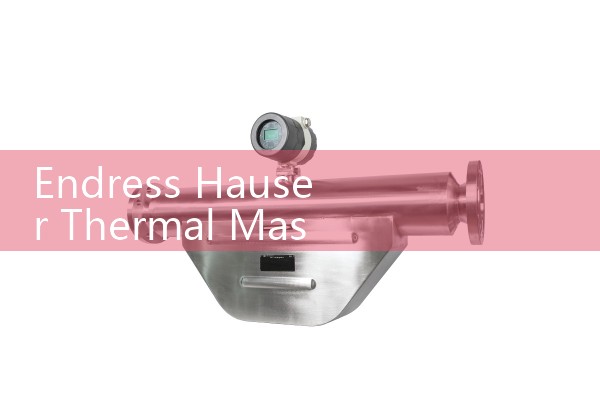
Silver Instruments thermal mass flow meters cover inline low gas flow from 0.01 kg/h to 50 kg/h for small line sizes. Insertion models cover dry gas up to 1000 kg/h in larger pipes. Our sensors use PT100 platinum elements and 316L stainless steel wetted parts. Output signals include 4-20 mA HART, pulse, and RS485 Modbus RTU.
Do not expect a thermal mass flow meter to work with wet gas or heavy liquid carryover. Coated sensors reduce heat transfer and cause low readings. In a gas stream with oil mist or moisture, install a filter or coalescer upstream.
Recommended Silver Instruments Models for Low Gas Flow
Inline model for DN15 to DN50 and 0.01 kg/h to 50 kg/h. Process connections can be wafer, threaded BSP or NPT, or flanged EN1092-1 and ANSI 150 LB. Wetted parts are 316L stainless steel with optional PTFE coating for slightly corrosive gas. The electronics can be remote mount with a 10 m cable.
Insertion model for DN80 to DN1000 and 1 kg/h to 1000 kg/h. Insertion length is field adjustable. It supports hot tap installation under pressure up to 16 bar. The local display shows kg/h, Nm3/h, total flow, and gas temperature.
For hazardous areas, Silver Instruments can supply thermal mass flow meters with ATEX Zone 1 or Zone 2 approvals. This matters for biogas and natural gas lines where the meter may sit in a classified area.
Ordering and Quote Checklist for Low Gas Flow Meters
Send us these values to get a thermal mass flow meter quotation: gas name or gas mixture, minimum flow rate, normal flow rate, maximum flow rate, operating pressure bar, gas temperature deg C, pipe diameter DN, process connection type, hazardous area classification, and output required. If you have an existing Endress Hauser t-mass model number, send that too. We can cross reference the line size and flow range.
Do not send only the pipe size and say low gas. Low gas flow is relative. A DN25 pipe carrying air at 0.1 bar and 25 deg C is different from the same DN25 pipe carrying methane at 2 bar and 40 deg C. The mass flow reading changes with gas properties.
Contact Silver Automation Instruments for a thermal mass flow meter quote. Tel: +86-25-68650347. WhatsApp: +86-25-52155837. WeChat: +86 15365082610.
FAQ
Can a Silver Instruments thermal mass flow meter replace an Endress Hauser t-mass meter?
Yes in many dry gas applications. Send your gas type, flow range, pipe diameter, process connection, and output signal. We will check whether the inline or insertion model matches the original installation.
What is the minimum measurable gas flow rate?
For inline meters with a reduced bore, the minimum is about 0.01 kg/h for air or nitrogen. For insertion meters in large pipes, the minimum depends on gas velocity and pipe diameter.
Does a thermal mass flow meter need long straight run?
Yes. A typical inline meter needs 15 DN upstream and 5 DN downstream from a single bend. If the bend is upstream of a control valve or half open valve, use 20 DN or more. A flow conditioner can reduce straight run.
Can the same meter measure different gases?
No. The meter must be configured for the actual gas composition. Air, methane, nitrogen, CO2, and biogas have different thermal properties. If the gas mixture changes often, send the range of gas composition so we can check the expected error.
What outputs are available?
Standard output is 4-20 mA HART with pulse and RS485 Modbus RTU. Optional local display and ATEX Ex d or Ex ia approvals are available for Zone 1 and Zone 2.
CTA: Send us your pressure in bar, temperature in deg C, pipe size in DN, gas type, and minimum and maximum flow rate. Quote requests are answered within 24 hours during working days.