

『Flow Meter Vs Flow Sensor: Differentiating Standalone Primary Elements from Full Instrument Transmitters』Related information(v cone flow meter|rotary gas meter|gallon meter|gear meter|metal tube rotameter|glass tube rotameter|nutating disk meter|transit time ultrasonic flow meter|wedge flow meter|pd meters|hydraulic flow meter|ultrasonic water flow meter|water flow meter|air flow meter|magnetic water flow meter|oxygen flow meter|gas flow meter|argon flow meter|air velocity meter|gasoline flow meter|fuel flow meter|ultrasonic water meter|digital water meter|nitrogen flow meter|solid flow meter|Oxygen tank flow meter|digital water flow meter|diesel fuel flow meter|steam flow meter|02 flow meter|compressed air flow meter|oil flow meter|liquid flow meter)
Flow Meter Vs Flow Sensor: Differentiating Standalone Primary Elements from Full Instrument Transmitters
Quick Answer: A flow sensor is the primary element only. It produces a raw pulse, frequency or small millivolt signal. A flow meter is a complete instrument with transmitter, display and calibrated output like 4-20 mA HART. For most industrial loops, order the full flow meter from Silver Automation Instruments, an industrial flow meter manufacturer and supplier with direct technical support.
What Is a Flow Sensor in Practice?
Most engineers call a flow sensor the part that touches the fluid and reacts to flow. In a vortex flow meter, the sensor is the shedder bar and the piezoelectric crystal. In an electromagnetic flow meter, the sensor is the electrode pair and the liner. In a Coriolis meter, the sensor is the vibrating tube. These elements give a small signal. A vortex sensor may give a frequency from 5 to 2000 Hz. A magmeter electrode pair gives only a few millivolts. A raw signal like that cannot drive a DCS input directly. You need a transmitter. Some suppliers sell only this primary element as a spare or as a component. That is fine if you already have a compatible converter. But on a new project a bare sensor often causes missing parts and extra wiring.
What Is a Flow Meter or Full Instrument Transmitter?
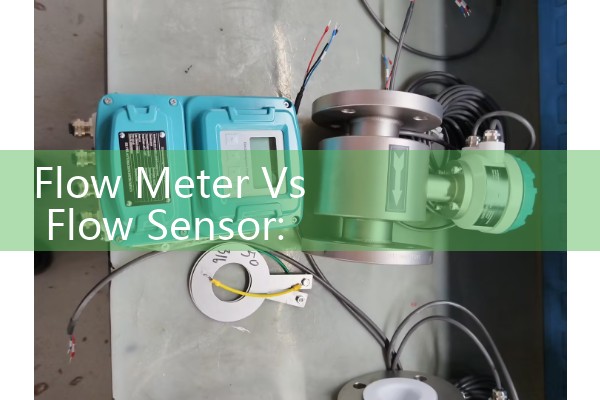
A flow meter combines the sensor and the transmitter in one device. Silver Automation Instruments supplies this as standard. For example our electromagnetic flow meter has the sensor tube, liner, electrodes and a converter mounted on the body. The converter powers the coils, reads the millivolt signal and gives isolated outputs. You get 4-20 mA HART, pulse, RS485 Modbus and a local backlit display. The unit is wet calibrated on a test rig before shipping. Accuracy for a magmeter may be plus or minus 0.5 percent of reading from 0.3 m/s to 10 m/s. That is a full instrument. In practice it is not a bare sensor.
Where The Confusion Shows Up On Quotes
We see this in emails from Southeast Asia, the Middle East and Latin America. A customer asks for a flow sensor for seawater. They write a line like flow sensor DN100, output 4-20 mA. But a sensor alone will not give 4-20 mA. That is a flow meter. Here is the thing. You need to specify the full package. Otherwise two suppliers may not quote the same scope. One supplier prices a bare electrode assembly. Another supplier prices a full electromagnetic flow meter with an IP67 converter. The price difference can be three times. This happened last year with a customer in Vietnam. They needed raw water flow measurement for a pump station. A local shop quoted only the sensor. The PLC had no pulse input. We supplied a DN150 electromagnetic flow meter with 4-20 mA, RS485 and a local display. The panel builder wired it in one afternoon. Most engineers skip this part. They assume the supplier includes the transmitter. Do not assume.
Outputs And Industry Terms That Matter
Ask for the output before you compare prices. A flow sensor often gives a frequency or a low level pulse. A flow meter gives conditioned outputs. Common industrial signals are 4-20 mA HART, 0-10 V, pulse, RS485 Modbus RTU and sometimes Profibus PA. For oil and gas skids in Nigeria or Oman, we often supply Coriolis mass flow meters with 4-20 mA HART plus pulse and Modbus. The transmitter computes mass flow in kg/h, volume flow, density and temperature. A bare sensor cannot compute anything. It only vibrates and produces a phase shift signal.
When Can You Use Only A Sensor?
Only if you have a matching transmitter or flow computer already installed. Some plants keep a spare primary element for an existing insertion thermal mass flow meter. A thermal mass flow sensor has two RTD elements and a heater. It gives a resistance change. The transmitter converts that to mass flow of air or gas. If the transmitter is fine, you can buy the insertion probe only. This is c
Silver Instruments Product Mapping
We supply full instruments. Some examples follow. Coriolis mass flow meter for crude oil loading in Nigeria. Size DN25, flow range 0 to 3000 kg/h, pressure 20 bar, temperature 50 °C, accuracy plus or minus 0.2 percent of rate. Outputs 4-20 mA HART, pulse and Modbus. This model works for diesel, palm oil, solvents and chemicals. Electromagnetic seawater flow meter for desalination plant in Oman. Size DN200, liner PTFE, electrodes 316L, conductivity above 5 µS/cm. The meter gives 4-20 mA HART and RS485. It handles flow from 20 m3/h to 400 m3/h. No pressure loss. Good for brine discharge and raw seawater intake. Vortex flow meter for steam in a Philippine feed mill. Size DN50, temperature 180 °C, pressure 8 bar. Built in PT100 temperature compensation. Output 4-20 mA HART. It measures steam mass flow in kg/h. Oval gear flow meter for glucose syrup in a Mexican candy factory. Size DN15, viscosity 5,000 cP, flow range 0.5 to 10 L/min. Pulse output and a small local batch display. This meter works by forced displacement of liquid. Thermal mass flow meter for biogas in a Vietnamese wastewater plant. Insertion probe with PT100 references. Flow range 0 to 200 Nm3/h. Gas temperature 35 °C. Output 4-20 mA HART and Modbus. For larger pipes, an ultrasonic flow meter from Silver Instruments can be clamp on or inline. We also supply pressure transmitters and paperless recorders. To get a detailed data sheet, contact Silver Automation Instruments on WhatsApp +86-25-52155837.
How To Specify A Flow Meter Quote
Send us the fluid, flow range, pipe size, temperature and pressure. Also tell us what output your PLC or SCADA needs. Power supply matters too. Most Silver Instruments flow meters accept 24 V DC. Some can accept 85 to 265 V AC. We need to know the hazard zone. For oil and gas sites, we can provide ATEX Zone 1 or IECEx versions. Include viscosity in cP if the fluid is not water. Include conductivity in µS/cm for electromagnetic flow meters. This short list prevents a wrong sensor selection.
FAQ
Q: Can I connect a flow sensor directly to a PLC?
A: Usually no. A raw pulse or millivolt signal needs a transmitter. Buy a full flow meter with 4-20 mA HART or Modbus unless your PLC has a dedicated high speed counter and signal conditioner.
Q: What is the price difference between a sensor and a flow meter?
A: It depends on size and material. A bare electromagnetic sensor may cost less than half of a complete meter. But a missing transmitter adds extra wiring, calibration and panel space. For new installations, the complete meter is usually cheaper in total cost.
Q: How do I know if a supplier quote includes the transmitter?
A: Check the output. If the quote says 4-20 mA HART, pulse, Modbus or has a local display, it is a full flow meter. If it says raw frequency or millivolt, you are likely buying a sensor only.
Q: Does Silver Instruments sell standalone flow sensors?
A: Yes for some probe type thermal mass meters and insertion vortex meters. But for electromagnetic, Coriolis and oval gear meters, we supply the complete flow meter. This avoids calibration mismatch.
Q: What flow meter do you recommend for seawater desalination?
A: An electromagnetic flow meter from Silver Instruments. Size DN50 to DN200, PTFE or rubber liner, titanium or 316L electrodes. It handles seawater conductivity around 52,000 µS/cm and gives 4-20 mA HART plus Modbus.
Contact Silver Automation Instruments
Call us at +86-25-68650347. WhatsApp +86-25-52155837. WeChat +86 15365082610. Send your pressure (bar), temperature (°C), pipe size (DN), and flow range. We will reply with a specific model and price in one business day.
 Hot Blog
 Related AD