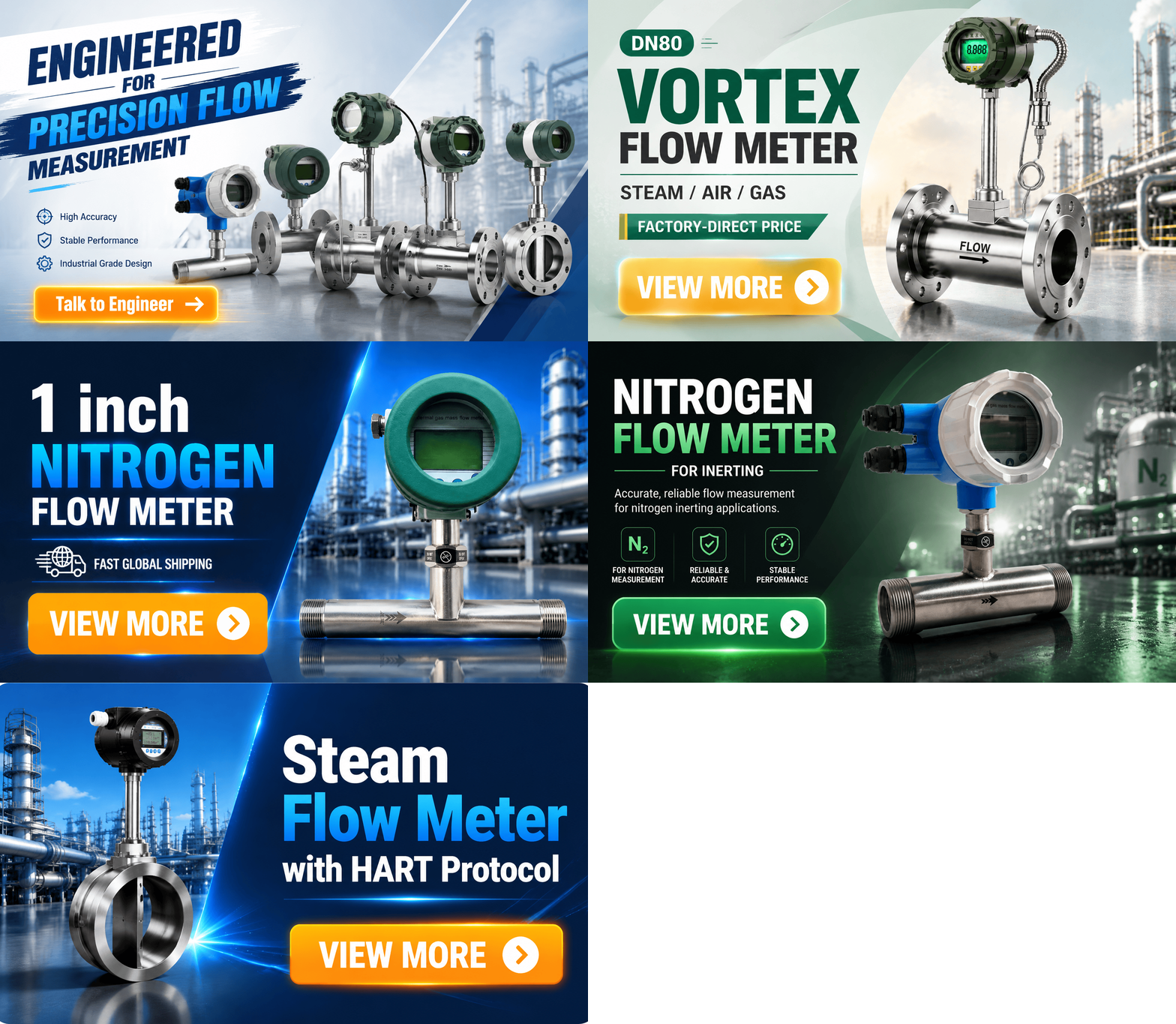


『How Much Does a Flow Meter Cost: Ranges from $50 for small consumer plastic rotameters to over $8,000 for high-end industrial Coriolis sets.』Related information(v cone flow meter|rotary gas meter|gallon meter|gear meter|metal tube rotameter|glass tube rotameter|nutating disk meter|transit time ultrasonic flow meter|wedge flow meter|pd meters|hydraulic flow meter|ultrasonic water flow meter|water flow meter|air flow meter|magnetic water flow meter|oxygen flow meter|gas flow meter|argon flow meter|air velocity meter|gasoline flow meter|fuel flow meter|ultrasonic water meter|digital water meter|nitrogen flow meter|solid flow meter|Oxygen tank flow meter|digital water flow meter|diesel fuel flow meter|steam flow meter|02 flow meter|compressed air flow meter|oil flow meter|liquid flow meter)
 ```html
How Much Does a Flow Meter Cost in 2025
Quick Answer: A small plastic rotameter costs about $50. A full Coriolis mass flow meter set for industrial use can exceed $8,000. Most process meters from Silver Automation Instruments land between $300 and $3,500 depending on line size, accuracy class, and wetted materials.
We get this question every week from customers in Malaysia, Vietnam, Mexico, and South Africa. The real answer depends on what you are measuring. Water. Diesel. Palm oil. Molasses. Natural gas. Each fluid pushes you toward a different meter type. So we will break down the price ranges by technology. Not by theory. By what our sales team quotes on a normal Tuesday.
Plastic Rotameters and Small Variable Area Meters
Price range: $50 to $180.
These are the little acrylic tubes with a float inside. Good for purge air, lab water, low pressure nitrogen. You see them in fertilizer plants and water labs across Indonesia and Nigeria. A DN15 plastic rotameter with a standard valve costs around $55. Add a stainless steel fitting and the price climbs to $120. Most engineers do not use these for custody transfer or aggressive chemicals. But for a visual flow check on a filter feed line they are hard to beat.
One caution. The plastic body gets cloudy with UV exposure. We have seen cracked bodies on rooftop installations in Queensland after two summers. For outdoor use with sunlight, ask for a metal tube rotameter or a basic magnetic flow meter instead.
Electromagnetic Flow Meters
Price range: $280 for compact DN25 to $2,800 for remote DN300.
Electromagnetic flow meters are the workhorse for water and wastewater. No moving parts. No pressure drop. They handle slurries and sludge. A compact DN50 mag meter with PTFE liner and 316L electrodes sells for about $420. The same meter with a remote display and Modbus output goes to $750.
Here is the thing. Diameter drives the price up fast. A DN300 flanged mag meter for a desalination plant brine line usually lands near $2,500. Add a calibration certificate for ISO 9001 requirements and the quote increases another $120. Most water utilities in the Philippines and Peru order the compact version because they do not want extra cable runs.
We recommend mag meters for conductivities above 5 µS/cm. For demineralized water or pure condensate skip the mag meter and go ultrasonic.
Ultrasonic Flow Meters
Price range: $500 for clamp-on transit time to $4,000 for fixed inline DN200.
Ultrasonic meters split into two groups. Clamp-on units mount outside the pipe. No cutting. No process shutdown. Inline units mount between flanges like a mag meter.
A basic clamp-on portable with PT100 temperature inputs costs around $650. This is popular with HVAC contractors measuring chilled water in office buildings in Bangkok and Dubai. The accuracy is not as tight as a Coriolis but the install time is one hour instead of one day.
A fixed inline ultrasonic meter for a DN150 cooling water loop with 4-20 mA and HART costs near $2,200. These are common in power plants and marine engine rooms. Accuracy runs about 0.5 to 1.0 percent of reading. Good enough for trending. Not for batching expensive chemicals.
Because ultrasonic meters need a clean, fully developed flow profile, we often suggest 10D upstream straight pipe. That means 10 times the pipe diameter before the meter. For a DN100 line that is one meter. Many installers skip this and then blame the meter.
Vortex Flow Meters
Price range: $450 for wafer DN50 to $2,600 for flanged DN150 with temperature compensation.
Vortex meters measure steam, compressed air, and saturated gas. Most of our Southeast Asian food processing customers use them for steam boiler efficiency tracking. A wafer DN80 vortex meter with integrated pressure sensor costs about $1,100. This gives you mass flow for steam when combined with a temperature input.
One specific detail. Do not use a vortex meter on low velocity lines. Below about 0.5 m/s for liquids the shedding stops and the meter reads zero even with flow. We have seen this on a palm oil mill in Malaysia where a bypass line ran all night at low flow and the meter missed it completely.
For saturated steam at 8 bar and DN100, a vortex meter with PT100 input and local display from Silver Instruments runs about $1,700. Add the pressure transmitter and you are at $2,100 all in.
Oval Gear Flow Meters
Price range: $320 for aluminum DN15 to $3,200 for stainless steel DN50.
Oval gear meters are positive displacement. They count pockets of fluid. This makes them great for diesel, lube oil, heavy fuel oil, and molasses. A paint manufacturer in Vietnam bought three stainless steel oval gear meters last year for dosing solvents into batch tanks. Each meter was DN25. Each cost about $1,400 with a pulse output.
The price gap comes from the body material. Cast iron is cheap. Stainless steel is not. A DN40 cast iron oval gear meter for diesel fuel transfer sells for $380. The same si
We always ask about viscosity when quoting oval gear meters. At high viscosity above 1000 cP the gears turn slower and the meter linearity improves. At low viscosity like gasoline the slip increases and accuracy drops. For gasoline and solvents, a turbine or Coriolis meter is usually better.
Thermal Mass Flow Meters
Price range: $600 for inline DN15 to $2,800 for insertion type for large ducts.
Thermal mass meters measure gas flow by heat dispersion. They work well for compressed air, natural gas, biogas, and flare gas. A DN25 inline thermal mass meter for compressed air with 4-20 mA output and local display costs about $850. This is common in automotive plants in Thailand tracking air usage by zone.
Insertion thermal mass meters are cheaper per installation for large pipes. You weld a ball valve fitting and insert the probe. For a DN400 compressed air header the meter itself may cost $1,400 but the installation is much simpler than cutting in an inline meter.
Gas composition matters. A thermal mass meter calibrated for air will read wrong on methane. We have seen errors over 15 percent on biogas lines where CO2 content varies day to day. If your gas mix changes, tell us the full composition before we quote.
Coriolis Mass Flow Meters
Price range: $2,500 for micro flow to $8,500 for DN80 high flow.
Coriolis meters are the premium option. Direct mass flow. Density. Temperature. No moving parts. Accuracy around 0.1 to 0.2 percent. They handle liquids, gases, and even two phase slurry in some cases.
A DN15 Coriolis meter from Silver Automation Instruments starts around $2,600. That gets you 316L stainless wetted parts, 4-20 mA HART, and a local display. This size is common for chemical dosing lines in Colombian coffee processing plants.
A DN50 Coriolis meter for a marine fuel oil transfer skid runs about $5,200. Add a remote transmitter, calibration for two fluids, and Ex proof certification for ATEX Zone 1 and the set approaches $7,000. This is the meter you buy when billing disputes are more expensive than the instrument.
Most engineers skip Coriolis because of the initial price. Then they add up the cost of a flow computer, temperature compensation, and recalibration on a volumetric meter. Sometimes the Coriolis ends up cheaper over three years. We have seen this on LNG truck loading in Indonesia. The customer replaced two turbine meters and a density meter with one Coriolis. Payback was 14 months.
What Changes the Price on Any Flow Meter
Line size. A DN15 mag meter is a few hundred dollars. A DN400 mag meter is several thousand. The electronics are nearly identical. You are paying for the metal, the liner, and the calibration rig time.
Wetted materials. 316L stainless is the default. Hastelloy C for aggressive acids triples the price. Tantalum electrodes for seawater add 40 percent over stainless. Titanium sits in the middle.
Outputs and protocols. A basic 4-20 mA output is standard. Add HART and the price moves up 10 percent. Modbus RTU adds $60 to $150 depending on the meter. Profibus or Foundation Fieldbus can add $400 or more because of the communication board.
Hazardous area certification. ATEX Zone 1 or IECEx adds $200 to $900 depending on the enclosure and barrier design. Intrinsically safe versions are usually the most expensive.
Calibration certificate. A standard factory certificate is included. A third party traceable certificate to ISO 17025 adds $150 to $350 per meter. For custody transfer or pharmaceutical batch records this is not optional.
Real Quotes from Our Team
A customer in Mexico asked for a seawater flow meter for a desalination plant intake line. DN200. The quote was $2,850 for an electromagnetic flow meter with rubber liner and titanium electrodes. Freight to Manzanillo added $110. Delivery was 18 days.
A dairy processor in Australia needed a sanitary flow meter for milk pasteurization. DN40. Tri clamp connections. 3A certification. We quoted a stainless steel oval gear meter at $2,150 plus $200 for the food grade calibration report. The customer compared it with a Coriolis at $5,600. They chose the oval gear because the CIP process already handles disassembly.
In practice the quote depends on five data points. Send us your pressure in bar, temperature in degrees Celsius, pipe size in DN, flow range in kg/h or m3/h, and the fluid you are measuring. That is enough for us to recommend the right meter and give you a real price in one day.
FAQ
How much does a basic water flow meter cost?
For clean water in a DN50 pipe, a compact electromagnetic flow meter costs about $400 to $600. For a DN100 line expect $700 to $1,000. If you only need a visual indication, a plastic rotameter under $100 may work.
Why are Coriolis flow meters so expensive?
The sensor tubes are precision machined and welded. The electronics measure phase shift at high
 Hot News
 Related AD