

『Engine Air Flow Meter Testing: How to Diagnose and Clean a Failing MAF Sensor』Related information(v cone flow meter|rotary gas meter|gallon meter|gear meter|metal tube rotameter|glass tube rotameter|nutating disk meter|transit time ultrasonic flow meter|wedge flow meter|pd meters|hydraulic flow meter|ultrasonic water flow meter|water flow meter|air flow meter|magnetic water flow meter|oxygen flow meter|gas flow meter|argon flow meter|air velocity meter|gasoline flow meter|fuel flow meter|ultrasonic water meter|digital water meter|nitrogen flow meter|solid flow meter|Oxygen tank flow meter|digital water flow meter|diesel fuel flow meter|steam flow meter|02 flow meter|compressed air flow meter|oil flow meter|liquid flow meter)
Engine Air Flow Meter Testing: How to Diagnose and Clean a Failing MAF Sensor
Quick Answer
A failing mass air flow (MAF) sensor sends an incorrect voltage or frequency signal to the engine control unit. Diagnose it with a digital multimeter and an OBD-II scan tool before replacing any part. Clean with dedicated MAF sensor spray only when the hot wire or hot film element is dirty.
Symptoms That Point to a Failing MAF Sensor
A failing MAF sensor rarely sets a hard fault at first. You may notice long crank time, rough idle, black smoke, poor fuel economy or a check engine light. Scan tools often show codes P0100, P0101, P0102 or P0103. These codes mean the MAF signal is missing, out of range, too low or too high. On a diesel pickup test bench in the Philippines, a customer found P0101 after an air filter service. The cause was dust on the hot film element, not a wiring fault.
Tools You Need for MAF Testing
Use an OBD-II scan tool, a digital multimeter, a back probe set and the vehicle wiring diagram. Do not pierce wire insulation with sharp probes. That invites corrosion later. A 0 to 5 volt DC signal is common on many hot wire MAF sensors. Some diesel MAF sensors output a frequency or pulse width signal, so check the service manual first.
How to Test a MAF Sensor with a Multimeter
Turn the ignition on but do not start the engine. Back probe the signal wire. On many Toyota and Nissan MAF sensors the signal wire sits at about 0.6 to 1.0 volt at warm idle. At 2500 rpm the voltage rises to roughly 1.5 to 2.2 volts. If the signal stays flat at 0.0 volt or climbs to a steady 5.0 volts, the sensor or the reference circuit has a problem. Check the 12 volt supply and ground first. We have seen technicians replace a good MAF sensor when the real fault was a bad ground near the battery.
How to Check a Frequency Based MAF Sensor
Some MAF sensors send a frequency signal instead of a DC voltage. Set your multimeter to Hz. At idle a Volkswagen TDI MAF may read around 500 to 1200 Hz. At full load the frequency rises. If the signal is frozen or zero, verify power and ground. Then check the signal wire from the MAF connector to the ECM pin with the harness unplugged. A wire harness rub through near the radiator support is a common fault on older vehicles in tropical climates.
When Cleaning Is Worth Trying
Cleaning solves only contamination problems. If the sensor is cracked, burnt or water damaged, cleaning will not help. Use a dedicated MAF sensor spray. Do not use brake cleaner, carb cleaner, petrol or compressed air at close range. The hot wire is delicate. Remove the MAF sensor from the housing. Spray the element for 2 to 3 seconds. Let it air dry for 15 minutes before refitting.
Here is the thing about air filters. A poor quality or incorrectly seated air filter lets fine dust past. That dust bakes onto the hot film element. In a 2023 case from a small fleet in Indonesia, three diesel pickups had unstable air flow readi
Relationship to Industrial Air Flow Meters
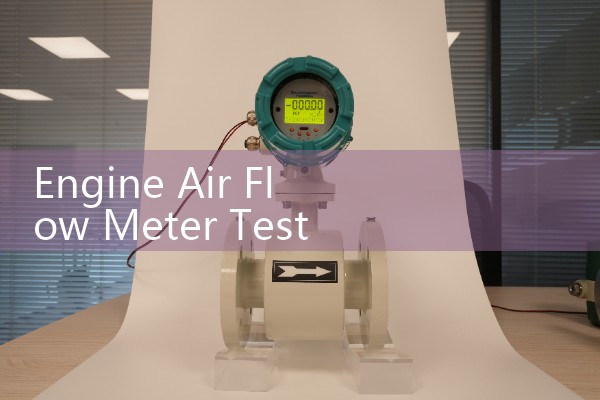
Engine MAF sensors are not built for continuous industrial air lines. They are lightweight, plastic and calibrated for narrow automotive ranges. For compressed air, blower air, methane, flue gas or biogas, a thermal mass flow meter with a stainless steel sensor is a better choice. Silver Automation Instruments supplies inline thermal mass flow meters with 4-20 mA HART output and optional RS485. Common sizes are DN15, DN25, DN50, DN80 and DN100. We have installed units on air lines at 7 bar, 22 degrees C and flow ranges from 1 to 900 Nm3/h. These are not MAF sensors, but they use a similar thermal principle scaled up with process connections.
How to Decide Between Cleaning and Replacement
Record the MAF signal at idle, 1500 rpm and 3000 rpm. A healthy sensor shows smooth rising values with no dropouts. A dirty sensor may lag or drift after long idle. A dead sensor stays fixed. If cleaning restores the signal within 10 percent of the service manual range, keep the sensor. If the signal still sits outside the range after cleaning, find the vacuum leak or exhaust leak first. Only then replace the MAF.
FAQ: Five Questions Engineers Ask About MAF Testing
Question 1. Can I test a MAF sensor without a scan tool? Yes. A multimeter is enough for basic voltage or frequency checks. A scan tool helps you see calculated grams per second and long term fuel trim together.
Question 2. What is a normal MAF reading at idle? Most 4-cylinder petrol engines show 2 to 5 grams per second at hot idle. Diesel MAF sensors may show 40 to 80 kg/h. Compare with the service manual because engine size changes the value.
Question 3. Can water damage a MAF sensor? Yes. Water vapor from a wet air filter or deep water crossing can stress the hot film. Let the sensor dry. If the signal remains high or low, replace it.
Question 4. How often should a MAF sensor be cleaned? Only when it is dirty. Do not schedule it like an oil change. We see dusty environments in the Middle East and mining sites in Australia shorten air filter life and dirty the MAF faster.
Question 5. Can an industrial air flow meter replace a MAF sensor on an engine? No. Do not fit an inline thermal mass flow meter into a vehicle intake. Industrial meters are for process lines and test benches. For a test bench, Silver Automation Instruments can supply a meter with a DC pulse, 4-20 mA or Modbus output to log air consumption.
For a quote on thermal mass flow meters or air flow instruments for your process, send your pressure in bar, temperature in degrees C, pipe size DN and expected flow range. For technical articles and product data, visit flow-meter.com.au. Contact Silver Automation Instruments by Tel: +86-25-68650347, Whatsapp: +86-25-52155837 or WeChat: +86 15365082610.
 Hot Product
 Related AD