

『Helium Gas Flow Meter Systems: Selecting High-Sensitivity Capillary Transmitters for Research』Related information(v cone flow meter|rotary gas meter|gallon meter|gear meter|metal tube rotameter|glass tube rotameter|nutating disk meter|transit time ultrasonic flow meter|wedge flow meter|pd meters|hydraulic flow meter|ultrasonic water flow meter|water flow meter|air flow meter|magnetic water flow meter|oxygen flow meter|gas flow meter|argon flow meter|air velocity meter|gasoline flow meter|fuel flow meter|ultrasonic water meter|digital water meter|nitrogen flow meter|solid flow meter|Oxygen tank flow meter|digital water flow meter|diesel fuel flow meter|steam flow meter|02 flow meter|compressed air flow meter|oil flow meter|liquid flow meter)

Helium Gas Flow Meter Systems: Selecting High-Sensitivity Capillary Transmitters for Research
Quick Answer
Helium gas flow meter systems for research rely on high-sensitivity capillary thermal mass flow transmitters when the flow range is low and the gas purity is high. A capillary transmitter with direct helium calibration is the practical choice for 0 to 5 sccm up to 0 to 1000 sccm. Silver Instruments supplies these meters with 4-20 mA HART, RS485 Modbus, and 1/8 inch or 1/4 inch fittings.
Why Helium Flow Measurement Needs a Capillary Transmitter
Helium has low density, high thermal conductivity, and a small molecular size. Research labs use helium for carrier gas control, leak testing, cryogenic cooling, and gas chromatography. Here is the thing. A standard air-calibrated thermal meter can misread helium by 15 to 40 percent. That error is too large for research work. A capillary transmitter with direct helium calibration avoids that problem.
In practice, most engineers skip the cheap air-calibrated rotameter for helium. They go straight to a capillary thermal mass flow meter because the output is linear and the zero drift is low. We have seen this on customer sites many times. A university lab in Perth replaced a glass tube rotameter with a 0 to 50 sccm helium capillary meter. The result was stable data on a gas chromatograph within two days.
Key Specifications for Research Applications
For helium gas flow meter systems, the following specs matter more than the brand name.
Range. Typical research ranges are 0 to 10 sccm, 0 to 20 sccm, 0 to 50 sccm, 0 to 200 sccm, and 0 to 1000 sccm. Do not buy a 0 to 50 L/min air meter for a 10 sccm helium stream. It will not resolve the low end.
Accuracy. A good capillary meter for helium should hold ±0.5 percent of reading plus 0.1 percent full scale for most lab work. Repeatability around ±0.2 percent of reading is common. For leak testing, repeatability matters more than absolute accuracy.
Wetted materials. 316L stainless steel is the standard. PTFE or FFKM seals are common. Some cryogenic labs ask for Hastelloy C276 for aggressive gas traces. Helium itself is inert, but the gas panel may see other media.
Fittings. 1/8 inch and 1/4 inch compression fittings are common in research. For helium tightness, VCR metal seals or Swagelok compatible fittings reduce leakage. A 0 to 20 sccm helium meter with 1/8 inch VCR fittings is a typical request from a vacuum leak test bench.
Output and power. 4-20 mA HART, 0 to 5 VDC, and RS485 Modbus RTU are standard. Power is usually 24 VDC. Some labs want a pulse output for total flow. Others need a 0 to 10 V signal for a DAQ card.
Pressure and temperature. Most capillary helium meters handle inlet pressures from 0.3 bar to 10 bar. Gas temperature is usually 0 to 50 °C. For cryogenic helium gas at very low temperature, send the exact temperature and pressure so we can check the sensor limits.
Selecting the Right Range and Fittings
Start with the minimum and maximum flow you must measure. A 0 to 1000 sccm meter may read a 2 sccm flow but the uncertainty at the low end can be high. If your experiment spends most of the time between 5 and 50 sccm, choose a 0 to 50 sccm or 0 to 100 sccm helium flow meter. That keeps the sensor in its best range.
Do not ignore the pressure drop. Helium is a small molecule and leaks through poor seals. A compact capillary meter with metal seals will serve better than a plastic body rotameter. Some labs in Singapore use 1/8 inch compression fittings with PTFE tape. That works for short runs, but VCR fittings are cleaner for long term helium service.
For gas chromatography, a 0 to 200 sccm meter often matches carrier and split flow duties. For helium leak detection, a 0 to 20 sccm or 0 to 50 sccm range is more common. Tell us your actual flow range in sccm, not the cylinder pressure or regulator setting. That saves time.
Installation and Signal Integration
Mount the capillary helium meter in a stable orientation. The sensor is sensitive to thermal drift. Keep it away from heaters, steam lines, and direct sunlight. A research lab in Saudi Arabia had a 0 to 20 sccm meter mounted next to a vacuum
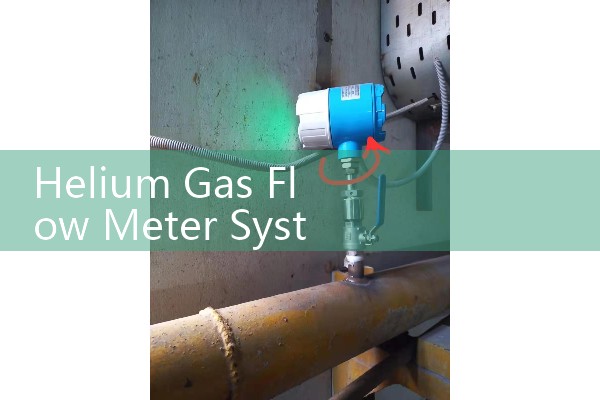
Signal wiring is simple. Most Silver Instruments capillary transmitters use an 8 pin M12 or a terminal box. The 4-20 mA loop connects to a PLC or DAQ with a 24 VDC supply. RS485 Modbus RTU is available for multi-drop setups. HART is an option for sites that want remote configuration without opening the housing.
Before calibration, run dry nitrogen or the process helium at a known flow for 15 minutes. This stabilizes the sensor. Do not power the meter only at the moment of measurement. Capillary sensors need a short warm up time for best zero stability.
Common Mistakes We See on Customer Sites
One mistake is improper zero. If the meter is not zeroed with the same gas and pressure as the process, the low end will drift. Zero the meter with helium, not air, and with the same back pressure.
Wrong fittings are another issue. Helium leaks through nylon ferrules and old PTFE tape. Use fresh metal ferrules or VCR gaskets. A small leak of 1 sccm can ruin a leak test or a carrier gas baseline.
Missing helium calibration is common. A meter calibrated for air can show a 15 to 40 percent error on helium when used in a capillary thermal mass flow sensor. Last year a customer in Vietnam asked us to replace a nitrogen-calibrated meter used on helium. The reading was 32 percent high. A 0 to 100 sccm helium capillary meter fixed the gas chromatograph baseline. Always request a helium calibration certificate from the factory. Silver Instruments includes NIST traceable calibration data with every helium capillary meter.
Undersized range happens often. A lab buys a 0 to 500 sccm meter for a 10 sccm process. The signal at 10 sccm is too close to the noise floor. Choose a range that puts the normal flow above 20 percent of full scale.
These are not rare cases. We have seen these issues on customer sites in Vietnam, Malaysia, and South Africa. They are easy to avoid if you specify the right gas type and flow range early.
FAQ
What flow range do I need for helium research?
Most research labs order 0 to 10 sccm, 0 to 20 sccm, 0 to 50 sccm, 0 to 100 sccm, 0 to 200 sccm, or 0 to 1000 sccm. The normal flow should be between 20 percent and 80 percent of full scale. If you are unsure, send the minimum and maximum flow in sccm and we will recommend a range.
Is air calibration acceptable for helium flow measurement?
No. Air and helium have different thermal conductivity and density. A capillary thermal mass flow meter needs a helium-specific calibration. Do not buy an air calibrated meter and apply a correction factor unless you have lab data to back it up.
Which fittings prevent helium leakage?
1/8 inch and 1/4 inch compression fittings, VCR metal seals, and Swagelok compatible fittings work well. Avoid soft plastic fittings. Helium leaks through poor seals because of its small molecular size. Use fresh metal gaskets for VCR connections.
Can I get a 4-20 mA HART output?
Yes. Silver Instruments offers 4-20 mA HART, 0 to 5 VDC, 0 to 10 VDC, and RS485 Modbus RTU outputs. The standard power supply is 24 VDC. Some versions also include a local display with total flow.
What is the lead time for a capillary helium flow meter?
A standard 0 to 50 sccm or 0 to 100 sccm meter in 316L stainless steel typically ships in 5 to 7 working days. Meters with Hastelloy C276, special fittings, or ATEX Zone 1 certification may take 2 to 3 weeks. We ship from our factory to Southeast Asia, Oceania, Latin America, Africa, and the Middle East.
Get a Quote for a Helium Capillary Meter
Send us your gas type, flow range in sccm or kg/h for larger systems, inlet pressure in bar, temperature in °C, fitting size, and output signal. For example, helium, 0 to 50 sccm, 2 bar, 25 °C, 1/8 inch VCR, 4-20 mA HART. You will get a specific model and price, not a generic brochure.
Contact Silver Automation Instruments at Tel: +86-25-68650347, WhatsApp: +86-25-52155837, or WeChat: +86 15365082610. We supply capillary helium flow meter systems to research labs, universities, and OEM builders in more than 30 countries.
 Hot Blog
 Related AD